


The Eight Limbs of Yoga: Maharshi Patanjali’s Complete Path to Self-Realization
- maakaliyogastudio
- Jun 27
- 4 min read

The Eight Limbs of Yoga: Maharshi Patanjali’s Complete Path to Self-Realization
When people hear the word Yoga, they often think of physical postures and stretching. While Āsana is an important aspect of Yoga, it is only one part of a much larger spiritual discipline.
More than two thousand years ago, Maharshi Patanjali systematically presented the complete path of Yoga in his Yoga Sutras, describing Yoga as a practical science for overcoming suffering and realizing one’s true nature.
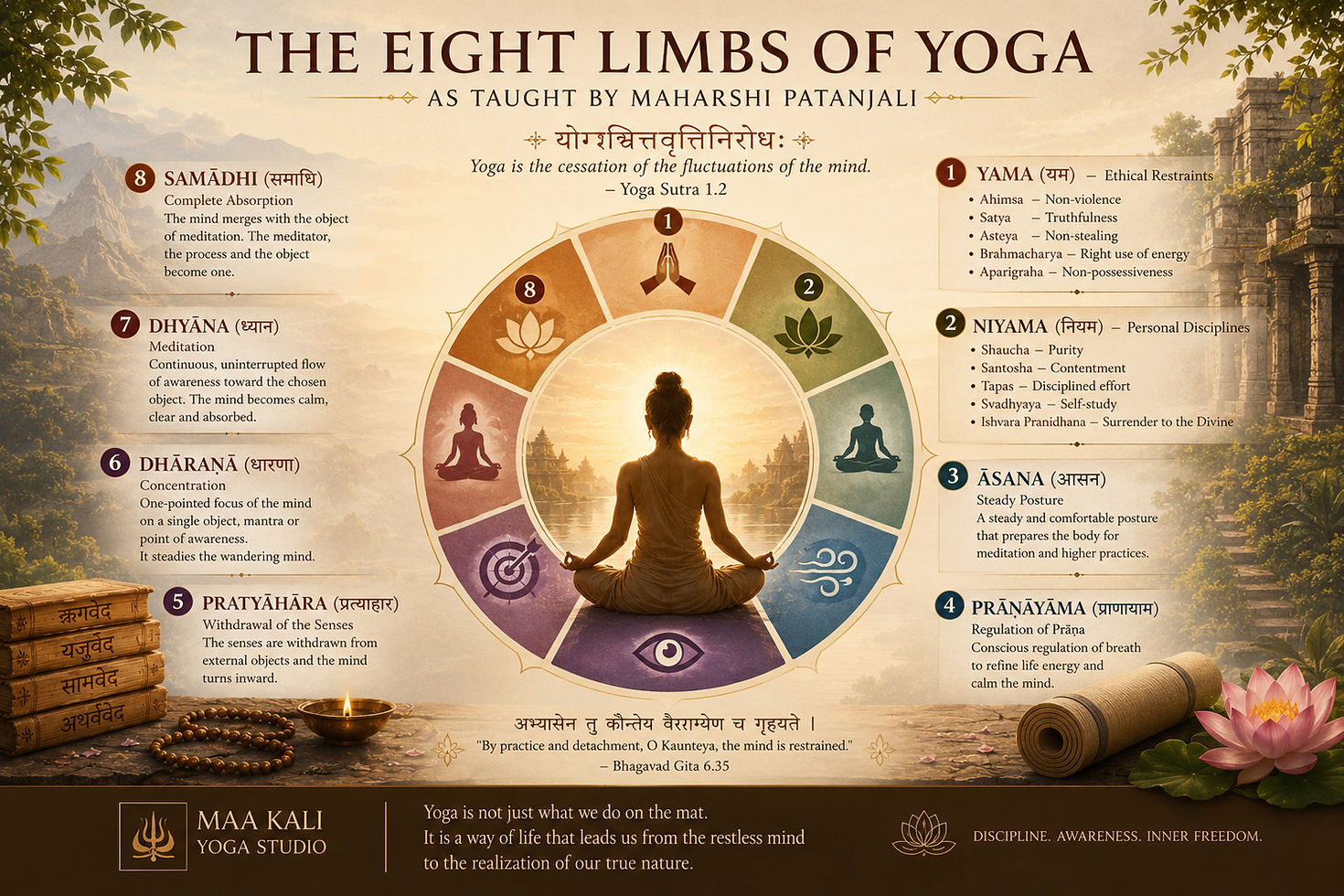
This path is known as Aṣṭāṅga Yoga—the Eight Limbs of Yoga.
The word Aṣṭāṅga comes from two Sanskrit words:
Aṣṭa (अष्ट) – Eight
Aṅga (अंग) – Limbs or branches
These eight limbs are not eight separate practices but eight interconnected aspects of one complete path that gradually transforms the practitioner from the outer world toward inner realization.
The Purpose of the Eight Limbs
Maharshi Patanjali defines Yoga in one of the most famous verses of the Yoga Sutras:
योगश्चित्तवृत्तिनिरोधः
Yogaś citta-vṛtti-nirodhaḥ (Yoga Sutra 1.2)
“Yoga is the cessation of the fluctuations of the mind.”
The Eight Limbs provide a systematic method for achieving this state. They begin by cultivating ethical living, continue through physical and mental discipline, and culminate in the direct realization of the Self.
1. Yama (यम) – Universal Moral Disciplines
Yama is the foundation of yogic living. It governs how we relate to others and the world around us.
Patanjali lists five Yamas:
Ahimsa – Non-violence
Satya – Truthfulness
Asteya – Non-stealing
Brahmacharya – Wise conservation and right use of energy
Aparigraha – Non-possessiveness
Without ethical living, higher yogic practices cannot become stable.
2. Niyama (नियम) – Personal Disciplines
Niyama concerns our relationship with ourselves and cultivates inner purity.
The five Niyamas are:
Shaucha – Purity
Santosha – Contentment
Tapas – Disciplined effort
Svadhyaya – Self-study and study of sacred texts
Īśvara Praṇidhāna – Surrender to the Divine
These observances strengthen character and prepare the mind for meditation.
3. Āsana (आसन) – Steady and Comfortable Posture
Today, Āsana is often considered synonymous with Yoga. Maharshi Patanjali, however, describes it very simply:
स्थिरसुखमासनम् (Yoga Sutra 2.46)
“Āsana is a posture that is steady and comfortable.”
Its purpose is not acrobatics or physical performance. A stable body allows the practitioner to sit comfortably for prolonged meditation without distraction.
Traditional Hatha Yoga further develops this foundation by strengthening, purifying, and balancing the body.
4. Prāṇāyāma (प्राणायाम) – Expansion and Regulation of Prāṇa
Prāṇa is the vital life force that animates all living beings.
Prāṇāyāma is more than breath control; it is the conscious regulation and refinement of this vital energy through disciplined breathing practices.
As the breath becomes calm and subtle, the mind naturally becomes calm and concentrated.
5. Pratyāhāra (प्रत्याहार) – Withdrawal of the Senses
Our senses constantly pull the mind toward external objects.
Pratyāhāra is the conscious withdrawal of attention from external distractions, allowing awareness to turn inward.
It serves as the bridge between the external disciplines and the inner practices of Yoga.
6. Dhāraṇā (धारणा) – Concentration
Dhāraṇā is the practice of fixing the mind upon a single point.
This object may be the breath, a mantra, a sacred symbol, or the Divine.
Instead of wandering endlessly, the mind learns to remain steady and focused.
Concentration is the beginning of meditation.
7. Dhyāna (ध्यान) – Meditation
When concentration becomes continuous and uninterrupted, it naturally matures into Dhyāna.
Meditation is not forcing the mind to be silent. Rather, it is a continuous, effortless flow of awareness toward the chosen object.
During Dhyāna, the mind becomes increasingly peaceful, clear, and absorbed.
8. Samādhi (समाधि) – Complete Absorption
Samādhi is the culmination of Yoga.
Here, the distinction between the meditator, the process of meditation, and the object of meditation dissolves.
The practitioner rests in pure awareness, free from the fluctuations of the mind.
This state ultimately leads to Kaivalya—complete liberation and freedom from suffering.
The Eight Limbs Are Not Steps
Although the limbs are presented sequentially, they are not rigid stages to be completed one after another.
Instead, they support and strengthen one another.
Ethical living deepens meditation.
Meditation strengthens concentration.
Breath regulates the mind.
The body supports the breath.
Together, the Eight Limbs create a harmonious and balanced path of transformation.
The Relevance of the Eight Limbs Today
Modern life is filled with distraction, stress, and constant activity.
The teachings of Maharshi Patanjali remain as relevant today as they were thousands of years ago because they address the root cause of human suffering—the restless mind.
The Eight Limbs remind us that Yoga is not merely something we practice for one hour a day.
Yoga is expressed through:
The way we treat others.
The discipline we cultivate.
The awareness we bring to our actions.
The steadiness of our breath.
The stillness of our mind.
It is a complete way of living.
Practicing the Eight Limbs at Maa Kali Yoga Studio
At Maa Kali Yoga Studio, we honor the authentic teachings of Maharshi Patanjali by integrating the principles of the Eight Limbs into every aspect of practice.
Our Hatha Yoga, Prāṇāyāma, Meditation, and Yoga Philosophy classes are designed not only to strengthen the body but also to cultivate discipline, awareness, compassion, and inner transformation.
Yoga is more than movement.
It is the journey from the restless mind to the peaceful Self.
As Maharshi Patanjali beautifully reminds us:
योगश्चित्तवृत्तिनिरोधः
“Yoga is the cessation of the fluctuations of the mind.”
May the Eight Limbs guide every seeker toward clarity, wisdom, and the realization of their true nature.

Comments