


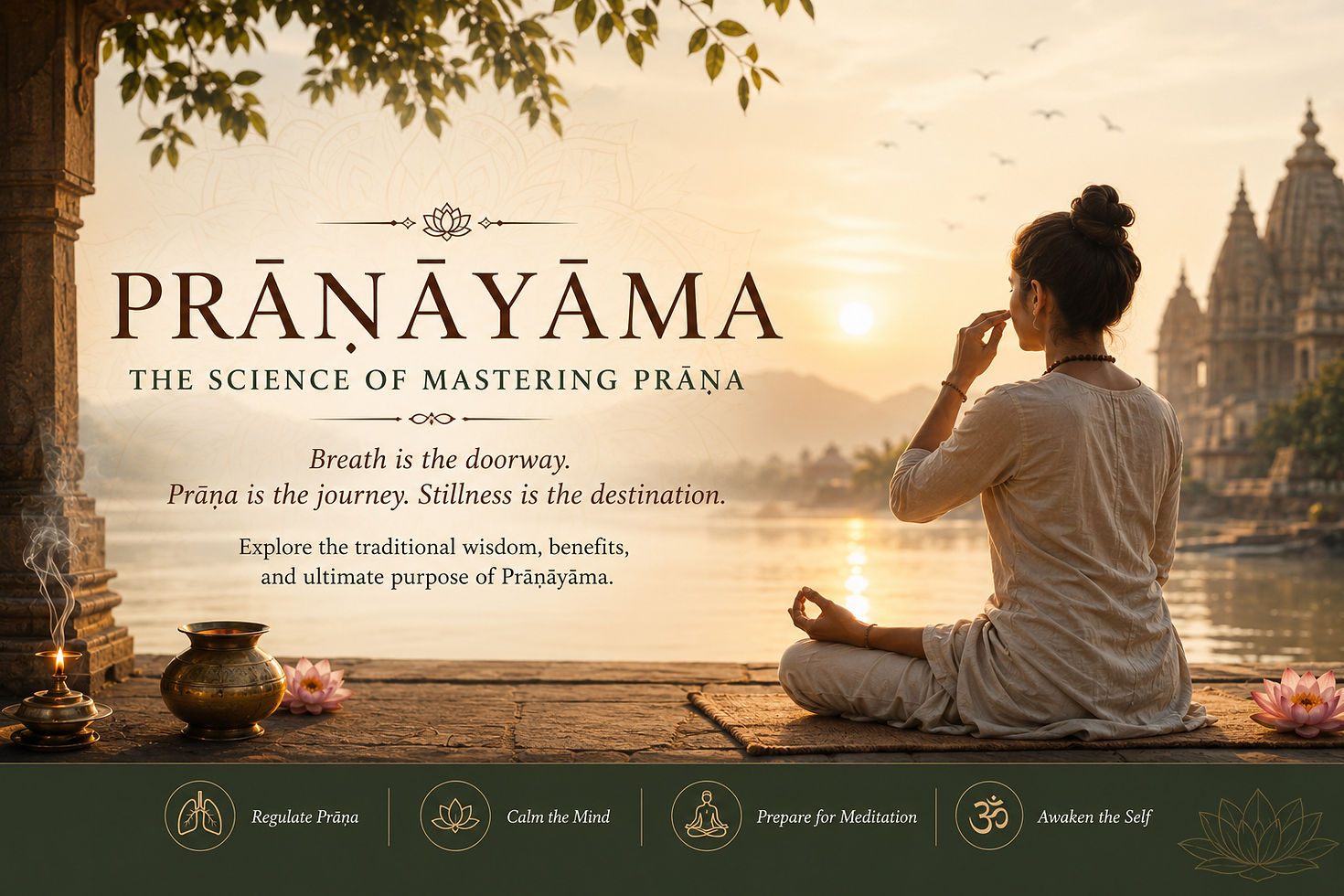
Prāṇāyāma: The Science of Mastering Prāṇa
- maakaliyogastudio
- Jun 27
- 5 min read

Prāṇāyāma: The Science of Mastering Prāṇa
Among the many practices of Yoga, Prāṇāyāma occupies a unique and sacred place. While it is often translated simply as “breath control,” the traditional scriptures reveal a far deeper meaning.
Prāṇāyāma is not merely a breathing exercise. It is the science of regulating Prāṇa—the universal life force that sustains every living being. Breath is only the doorway; the true objective is mastery over the subtle energies of the body, purification of the mind, and preparation for the highest state of Yoga.
Maharshi Patanjali places Prāṇāyāma as the fourth limb of Aṣṭāṅga Yoga, following Yama, Niyama, and Āsana. Once the body is steady and the mind is disciplined, the practitioner becomes ready to refine the flow of Prāṇa.
What is Prāṇa?
The Sanskrit word Prāṇa is often translated as “breath,” but this translation is incomplete.
Prāṇa is the vital life force that animates all living beings. It governs every heartbeat, every movement, every thought, and every breath. Breath is the gross manifestation of Prāṇa, while Prāṇan itself is the subtle energy that permeates the entire body.
The ancient yogis observed a profound relationship between the breath and the mind.
When Prāṇa is disturbed, the mind becomes restless.
When Prāṇa is balanced, the mind naturally becomes calm and focused.
Thus, the regulation of breath becomes the doorway to the regulation of consciousness.
What Does Prāṇāyāma Mean?
The word Prāṇāyāma has two accepted traditional interpretations.
Prāṇa + Āyāma
Āyāma means expansion, extension, or refinement.
Prāṇāyāma therefore means the expansion and refinement of the life force.
Prāṇa + Yāma
Another interpretation derives it from Yāma, meaning regulation or restraint.
Here, Prāṇāyāma means the conscious regulation and mastery of Prāṇa.
Both meanings complement each other and point toward mastery over one’s vital energy.
Prāṇāyāma According to Maharshi Patanjali
After establishing steadiness in Āsana, Patanjali defines Prāṇāyāma:
तस्मिन् सति श्वासप्रश्वासयोर्गतिविच्छेदः प्राणायामः
Tasmin sati śvāsa-praśvāsayor gati-vicchedaḥ prāṇāyāmaḥ. (Yoga Sutra 2.49)
“Once steadiness in posture has been attained, Prāṇāyāma is the regulation of the movements of inhalation and exhalation.”
He further explains:
ततः क्षीयते प्रकाशावरणम् (Yoga Sutra 2.52)
“Then the veil covering the inner light becomes thin.”
And finally:
धारणासु च योग्यता मनसः (Yoga Sutra 2.53)
“The mind becomes fit for concentration.”
These sutras reveal the true purpose of Prāṇāyāma: it prepares the mind for Dhāraṇā (concentration), which naturally matures into Dhyāna (meditation) and ultimately Samādhi.
Prāṇāyāma in the Hatha Yoga Tradition
The Haṭha Yoga Pradīpikā declares:
“When the breath is unsteady, the mind is unsteady. When the breath is steady, the mind becomes steady.”
Rather than attempting to silence the mind directly, the yogi first steadies the breath. As the breath becomes subtle, the fluctuations of the mind gradually diminish.
For this reason, Prāṇāyāma is regarded as one of the most powerful practices in Hatha Yoga.
The Classical Components of Prāṇāyāma
Traditional Prāṇāyāma consists of three fundamental stages:
Pūraka (पूरक) – Inhalation
The conscious drawing in of breath with awareness and ease.
Kumbhaka (कुम्भक) – Retention
The gentle retention of the breath, allowing Prāṇa to stabilize and become concentrated.
Recaka (रेचक) – Exhalation
The slow, controlled release of the breath, calming the nervous system and quieting the mind.
Each stage should be practiced smoothly, without force or strain.
The Highest Goal: Kevala Kumbhaka
The ancient yogis regarded Kevala Kumbhaka as the pinnacle of Prāṇāyāma.
Unlike intentional breath retention, Kevala Kumbhaka is the spontaneous suspension of breath that arises naturally in deep meditation.
There is no effort, no forcing, and no holding.
As the mind becomes perfectly still, the breath itself becomes subtle and eventually rests on its own.
This effortless stillness is considered one of the great signs of advanced yogic practice and serves as a gateway to Samādhi.
The Benefits of Prāṇāyāma
With regular and disciplined practice, Prāṇāyāma offers benefits on multiple levels.
Physical Benefits
Improves respiratory efficiency.
Supports cardiovascular health.
Enhances oxygen utilization.
Increases vitality and endurance.
Promotes healthy breathing patterns.
Mental Benefits
Calms the nervous system.
Improves concentration.
Reduces stress and mental agitation.
Enhances emotional balance.
Develops greater clarity and awareness.
Spiritual Benefits
Purifies the subtle energy channels (Nāḍīs).
Balances the flow of Prāṇa.
Prepares the mind for meditation.
Deepens inner awareness.
Leads toward Kevala Kumbhaka, Dhyāna, and Samādhi.
Limitations and General Contraindications
Prāṇāyāma is a subtle and powerful practice that should always be approached with patience and awareness.
While gentle breath awareness is suitable for most individuals, vigorous breathing techniques and prolonged breath retention require proper instruction.
General Guidelines
Practice on an empty stomach or at least 2–3 hours after a meal.
Choose a clean, quiet, and well-ventilated place.
Sit in a steady and comfortable posture.
Never strain, force, or compete with the breath.
Progress gradually under the guidance of a qualified teacher.
If you experience dizziness, discomfort, or unusual symptoms, stop the practice and return to natural breathing.
General Contraindications
Certain practices—especially vigorous techniques and prolonged Kumbhaka (breath retention)—should be avoided or modified under expert guidance if you:
Have uncontrolled high or low blood pressure.
Have significant heart or respiratory conditions.
Are recovering from major surgery or serious illness.
Have a fever or acute infection.
Experience severe dizziness or balance disorders.
Are pregnant, as certain techniques may be unsuitable.
Have been advised by a healthcare professional to avoid breath-retention or strenuous breathing practices.
A Traditional Reminder
The classical texts repeatedly emphasize that Prāṇāyāma should be practiced gradually (śanaiḥ śanaiḥ) and never with force.
The purpose is not to hold the breath for the longest time or to master advanced techniques quickly. True progress comes through patience, humility, consistency, and awareness.
As the breath becomes gentle, the mind becomes quiet.
As the mind becomes quiet, meditation unfolds naturally.
In the yogic tradition, quality of awareness is always valued above quantity of technique.
Prāṇāyāma at Maa Kali Yoga Studio
At Maa Kali Yoga Studio, Prāṇāyāma is taught according to the wisdom of the Yoga Sutras and the classical Hatha Yoga texts.
Our classes emphasize proper posture, breath awareness, gradual progression, and inner transformation rather than performance or force.
Students are guided to cultivate steadiness, balance, and mindfulness, allowing the practice to become a bridge from the body to the breath, from the breath to the mind, and from the mind to the Self.
Prāṇāyāma is not simply about breathing better.
It is about refining Prāṇa, preparing the mind for meditation, and progressing toward the effortless stillness of Kevala Kumbhaka, Dhyāna, and ultimately Samādhi.
As Maharshi Patanjali teaches, the disciplined regulation of breath makes the mind fit for concentration. From that stillness arises meditation, and from meditation, the realization of our true nature.
Disclaimer
This article is intended for educational purposes only and is not a substitute for professional medical advice. If you have a medical condition, are pregnant, or are recovering from illness or surgery, consult your healthcare professional before beginning Prāṇāyāma. Advanced techniques, particularly breath retention (Kumbhaka), should always be learned under the guidance of a qualified yoga teacher.

Comments