


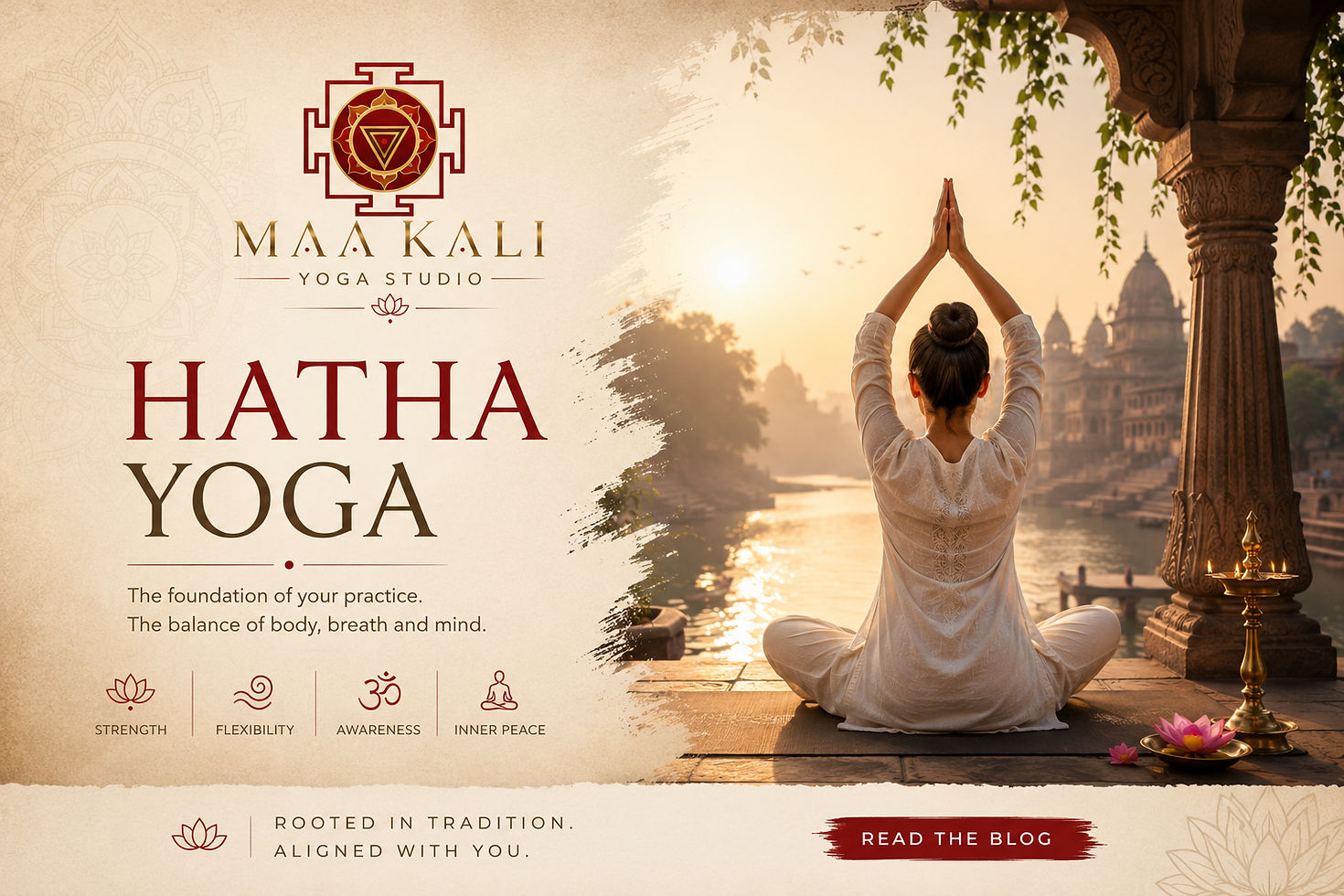
Hatha Yoga: The Sacred Discipline of the Body, Breath, and Mind
- maakaliyogastudio
- Jun 27
- 4 min read

Hatha Yoga: The Sacred Discipline of the Body, Breath, and Mind
Hatha Yoga is among the most influential traditions within the vast science of Yoga. Today, it is often understood as a series of physical postures or a gentle form of exercise. Traditionally, however, Hatha Yoga is a complete spiritual discipline designed to purify the body, regulate prāṇa (vital energy), steady the mind, and prepare the practitioner for the higher states of meditation described in the Yoga Darśana of Maharshi Patañjali.
The ancient yogis viewed the body not as an obstacle to spiritual growth but as a sacred instrument. Through disciplined practice, the body becomes steady, the breath becomes refined, and the mind naturally turns inward toward Self-realization.
The Origins of Hatha Yoga
According to the yogic tradition, the knowledge of Hatha Yoga originates with Ādi Yogi Bhagavān Śiva, who is revered as the first teacher of Yoga. The scriptures describe Śiva imparting these teachings to Matsyendranātha, who became one of the earliest human masters of the Nātha Sampradāya. Matsyendranātha transmitted this wisdom to his disciple Gorakṣanātha, whose teachings played a central role in preserving and spreading Hatha Yoga throughout the Indian subcontinent.
While these teachings were transmitted orally for centuries, several great masters later compiled them into written texts that remain the principal sources of traditional Hatha Yoga.
The three most important classical texts are:
Haṭha Yoga Pradīpikā
Compiled in the 15th century by Svātmārāma Yogī, this is the most influential manual on Hatha Yoga. Rather than creating a new system, Svātmārāma states that he compiled the teachings of the earlier Siddhas and Nātha Yogis. The text explains āsana, prāṇāyāma, mudrā, bandha, samādhi, and the relationship between Hatha Yoga and Rāja Yoga.
Gheraṇḍa Saṁhitā
Attributed to Sage Gheraṇḍa, this text presents Yoga as a gradual sevenfold discipline (Sapta Sādhana), emphasizing purification, strength, steadiness, patience, lightness, meditation, and realization. It provides detailed instruction on cleansing practices, āsanas, mudrās, prāṇāyāma, and meditation.
Śiva Saṁhitā
Traditionally presented as a dialogue spoken by Lord Śiva to Pārvatī, the Śiva Saṁhitā combines yogic practice with Vedāntic philosophy. It discusses the subtle body, nāḍīs, prāṇa, kuṇḍalinī, meditation, and the ultimate unity of the individual Self with the Supreme Reality.
These texts do not contradict one another. Instead, they complement each other, presenting Hatha Yoga as a complete path of physical, energetic, mental, and spiritual refinement.
What Does “Hatha” Mean?
The Sanskrit word Haṭha has several traditional interpretations.
One interpretation explains “Ha” as the solar principle and “Tha” as the lunar principle. Hatha Yoga seeks to harmonize these complementary energies within the practitioner, allowing prāṇa to flow freely through the subtle body.
Another interpretation derives the word from haṭha, meaning steadfast effort, discipline, or determined practice. This reflects the commitment required to master the body, senses, breath, and mind.
Both interpretations point toward the same objective: preparing the practitioner for higher states of Yoga.
The Purpose of Hatha Yoga
The purpose of Hatha Yoga is clearly stated in the opening verses of the Haṭha Yoga Pradīpikā.
“Haṭha Vidyā is taught solely for the attainment of Rāja Yoga.” (Haṭha Yoga Pradīpikā 1.2)
This single verse reveals the true intention of Hatha Yoga.
The physical practices are not the final goal. They prepare the practitioner for meditation by creating a body that is healthy, a nervous system that is balanced, a breath that is subtle, and a mind that is free from agitation.
In other words, Hatha Yoga is the foundation upon which deeper yogic practices are built.
The Complete Practice of Hatha Yoga
Traditional Hatha Yoga extends far beyond physical postures. It encompasses an integrated system of practices that work on every dimension of the human being.
These include:
Ṣaṭkarma – the six cleansing techniques that purify the body.
Āsana – cultivating steadiness and ease in the body.
Prāṇāyāma – refining and regulating the life force through conscious breathing.
Mudrā – energetic seals that direct prāṇa within the body.
Bandha – internal locks used to preserve and channel vital energy.
Pratyāhāra – withdrawing the senses from external distractions.
Dhyāna – meditation leading toward inner stillness.
Together, these practices prepare the practitioner for the higher states of concentration and ultimately Samādhi.
Āsana: More Than Physical Exercise
Today, yoga is often identified with increasingly complex postures. The traditional texts present a different perspective.
An āsana is valuable not because it is difficult but because it develops:
Stability
Ease
Awareness
Balanced breathing
Physical endurance for meditation
Every posture becomes an opportunity to cultivate mindfulness rather than performance.
Breath: The Bridge Between Body and Mind
In Hatha Yoga, breath is regarded as the bridge between the physical and subtle dimensions of our being.
When the breath is disturbed, the mind becomes restless.
When the breath becomes calm, smooth, and rhythmic, the mind naturally follows.
This is why every traditional Hatha Yoga practice emphasizes synchronized movement with conscious breathing, eventually leading to the practice of Prāṇāyāma.
The Fruits of Hatha Yoga
Although Hatha Yoga naturally improves strength, flexibility, posture, mobility, and overall health, these are considered secondary benefits.
Its deeper purpose is the transformation of the practitioner through:
Physical purification
Mental steadiness
Emotional balance
Greater vitality
Heightened awareness
Inner silence
Preparation for meditation and Self-realization
Hatha Yoga at Maa Kali Yoga Studio
At Maa Kali Yoga Studio, Hatha Yoga is taught with reverence for its classical roots. Our approach goes beyond physical fitness, honoring the wisdom preserved by the Nātha Yogis and the traditional scriptures.
Each class integrates mindful movement, conscious breathing, relaxation, and traditional yogic principles, helping students experience Yoga as a complete path of transformation.
Whether you are stepping onto the mat for the first time or deepening an established practice, Hatha Yoga offers a timeless method for cultivating health, discipline, inner balance, and spiritual growth.
“The body becomes steady. The breath becomes subtle. The mind becomes still. In that stillness, Yoga reveals itself.”

Comments